About SHOCK•TEK™
Shock•Tek™ LLC was founded in 1996 to produce market and distribute products incorporating Dr. A. Robert Spitzer MD’s revolutionary, patented technology. Shock•Tek’s Carpal Tunnel Device is easily incorporated into almost any type of glove to help with the pain and discomfort caused by excessive pressure to the carpal tunnel nerve. Shock•Tek™ LLC produces Gloves for industry, sport and home use. Our gloves are used extensively by auto plants - GM, Ford and Chrysler - as well as many other major industrial corporations including Caterpillar, Boeing, Sikorsky Aircraft, Spirit Aero Systems and Sealy Mattress.
Why Do I Have Trouble Using My Hands?
CTS is a serious, painful and disabling neurological condition caused by damage to the median nerve which extends through the wrist and into the hand at the center of the base of the palm. CTS is the most common form of Repetitive Stress Injury (RSI). RSI affects over 100,000 people a year whose repetitive tasks – such as grasping, stapling and pressing – place continual stress on parts of their bodies. Symptoms include numbness, tingling, painful and burning fingers, weakness of grip and aching hands. Severe, chronic cases result in permanent and painful weakness, often requiring surgery.
Facts About Carpal Tunnel Syndrome
CTS can be prevented through avoiding pressure to the nerve and using protection, conditioning exercises, rest periods and modifying movement and jobs.
There are two main causes of damage to the median nerve that lead to CTS:
1. Direct impact, prolonged pressure or vibration applied to the palm of the hand, as during heavy machine operation. In addition to direct mechanical damage, pressure compresses the veins and blocks blood circulation to the nerve. It also starts a vicious cycle by blocking lymphatic drainage, which in turn further increases the pressure.
2. Extending and flexing the wrist back and forth rapidly, or moving the fingers extremely rapidly during activities such as typing which can cause kinking of the nerve or friction from the rubbing tendons.
What causes Carpal Tunnel Syndrome?
Peripheral nerves can be injured in several different ways. Obviously, they can be severed by a cutting injury. Local injury otherwise occurs due to focal pressure. We would like to refer you to an excellent, detailed textbook on peripheral nerve injuries by Dawson, Hallett and Millender (referred to as DHM) (Note- See our Glossary of some useful terms on our About Us page.)
Experiments in guinea pigs by Gilliatt in the 1960’s demonstrated demyelization in nerves subject to pressure. In more severe cases, axonal loss was demonstrated as well. Denny-Brown and Brenner hypothesized an ischemic mechanism of injury, but histological studies show that a high pressure, myelin is physically damaged. Some informative photomicrographs by the late Dr. Gilliatt appear on page 11 of the DHM textbook. (I had the pleasure to work with Drs. Hallett and Gilliatt at the National Institutes of Health years ago.– A. Robert Spitzer, MD).
According to Dawson, Hallett & Millender, “Observations support the idea that mechanical factors and not ischemia are critical in the lesion of chronic entrapment. The mechanical factor responsible has not been identified, but it may be chronic low pressure or friction.”
There is also evidence to support ischemia as an important mechanism, as reviewed in DHM. Studies have been performed in which catheters have been introduced directly into the carpal tunnel where the actual pressure in the tunnel is measured.
The pressure in the carpal tunnel in individuals having CTS is higher than in normal individuals (about 30-35 mm HG). This is interesting because the central venous pressure is about 40 mm. In other words, the pressure in the veins is about 40 mm. Veins are soft and collapsible. An external pressure close to 40 mm can easily collapse the veins and cut off blood flow. Thus, the critical pressure for developing CTS seems to be about the same pressure it takes to cut off return of circulation by the venous system. Lower pressures don’t seem to predispose to the problem.
In summary, the basic pathophysiology of CTS is excess pressure. Keeping pressure down on the carpal tunnel is a logical way to try to prevent this disorder, based on our knowledge of physiology.
There are three common mechanisms to injure the median nerve:
By repeatedly flexing and extending the wrist.
By moving the fingers rapidly, causing nerve friction.
By external pressure or vibration applied to the palm of the hand.
The Shock-Tek™ glove addresses this third mechanism. It reduces the external pressure, impact or vibration applied to the carpal tunnel and median nerve. Different jobs and sports require different hand actions, resulting in different combinations of the above causative factors. Even if two or three of these factors are present, the Shock-Tek™ glove will often help, if the external pressure is a significant part of the overall problem. However, if the entire problem is finger movement or flexion and extension of the wrist, the glove would not be expected to provide much benefit.
CTS is considered a “Cumulative Trauma Disorder” (CTD). The development of CTS results from a summation of one or more factors over time. If the more precipitating factors are present, the stronger each factor, and the longer the time of exposure, the more likely one is to develop the injury. Considered mathematically, this could be expressed as
CTS = v∑factor dtt
In addition to direct pressure on the nerve, finger movement, wrist flexion and extension, there are medical contributory factors, such as diabetes, alcohol consumption, certain genetic factors and vitamin deficiencies. The stronger each factor, the more factors present, and the longer the time they are applied, the more likely is CTS.
What are the Symptoms of Carpal Tunnel Syndrome?
In most cases of CTS, the symptoms are fairly stereotypical. The predominant symptoms are numbness and tingling of the thumb, index and middle finger. These symptoms may be intermittent. Tingling of the small (5th) digit is usually not CTS. Pain usually only occurs in late stage or severe disease. Numbness is much more common than pain. Because of the tingling, many people who have the earliest stages of CTS, or have an extremely mild, reversible nerve injury, mistakenly think they have poor circulation in the hand. Poor circulation in the hand is a very rare condition. So, many people without definite CTS or who haven’t developed it yet, can get relief of symptoms when using the Shock-Tek™ glove.
Loss of grip strength can develop particularly due to weakness of the thumb muscles. Some patients report dropping things from their hand. Sometimes, this is a false weakness and is due to loss of sensation. For example, some patients say they drop things from their hand only if they are not looking at the object (i.e. they can’t feel it).
Please note! Several other conditions other than CTS can cause numbness or weakness of the hand, including conditions such as stroke, MS and spinal cord injury. If you are not sure about your problem, please see your doctor. Information at this web site is informational only, and is not meant to replace proper medical evaluation, diagnosis and treatment. Use of the Shock-Tek™ glove is not intended as a substitute for proper medical care. If you think you have a medical problem affecting the hand, please see your doctor.
Preventing Carpal Tunnel Syndrome
Forceful gripping and repetitive hand and wrist movements over prolonged periods of time can lead to a variety of wrist and hand problems, including CTS. Being aware of the risks and symptoms of CTS and knowing what can be done to protect the sensitive median nerve area can help prevent this condition.
Some recommendations
Avoid pressure on the median nerve. Damage to the median nerve causes CTS. The median nerve crosses through the wrist and enters the hand at the center of the base of the palm, carrying sensation from the hand to the central nervous system. Extended or repetitive pressure, particularly over the unprotected median nerve area, can lead to CTS and cause permanent damage to the nerve.
Avoid extended flexing of the wrist. Whenever possible, keep the wrist straight, and avoid using it in a bent or twisted position over prolonged periods of time.
Grip with the whole hand. Use the entire hand when grasping objects. Grasping with just the thumb, index and middle fingers, increases pressure on the wrist.
Minimize repetitive motions. Any repeated motion of the hands can strain the median nerve, causing CTS. Continuous, rapid movement of the fingers or wrists – as when typing – can cause kinking of the median nerve or friction from the rubbing of tendons. Prolonged gripping and other forms of pressure on the nerve can also cause CTS. When you use tools or equipment of any kind, vary your technique, grip and position. Avoid holding an object the same way for a long period of time.
Rest your hands. Rest and stretch your hands if they become tired. Alternating tasks, rotating work activities or regularly switching hands will help prevent injury.
Minimize speed and pressure. Forceful repeated movements can put extra stress on the sensitive wrist area. In some cases, power tools can reduce the work but they need to be used with caution, since extreme vibration can also introduce CTS. No matter what the task, pause to consider how tools might be used most safely.
Ask your doctor about conditioning exercises. Certain exercises can strengthen the hands and arm muscles to help avoid pressure or strain on the wrists.
NOTE: The above suggestions are not meant to take the place of a physician’s care and may not prevent all of the different medical problems that can affect the hands.
How SHOCK•TEK™ Works
Prevention, Protection, Relief
The Shock-Tek™ protective device, when incorporated with the proper glove, has been proven to help prevent, protect, and provide relief for Carpal Tunnel Syndrome (CTS).
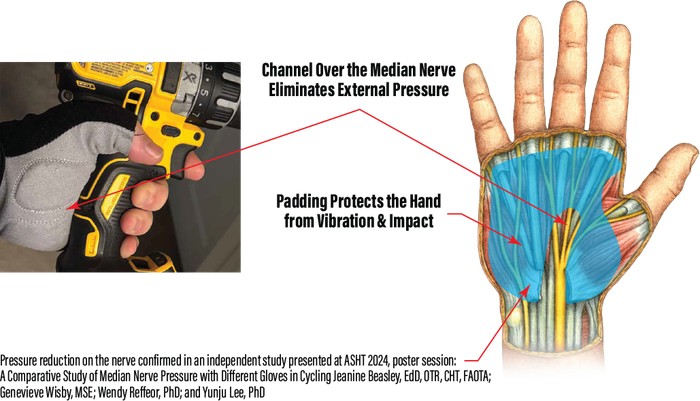
It is placed precisely to coincide with the anatomy of the human hand. The design has undergone repetitive, extensive testing in industrial and sports applications to determine the best location and dimensions for the placement of the channel in order to best protect the median (carpal tunnel) nerve.
The median nerve controls movement of the thumb and carries sensation from the hand to the central nervous system. The median nerve is most prone to injury in the area of the carpal tunnel, a narrow, 4-6 cm long canal that runs vertically from the wrist to the middle of the palm.
The basic pathophysiology of CTS is excess pressure. Keeping pressure down on the carpal tunnel is a logical way to try to prevent CTS based on our knowledge of physiology.
In certain jobs and sports, external pressure is the biggest contributing factor to CTS. Shock-Tek™ has been developed for those jobs and sports.
Our SHOCK•TEK™ Gloves Provide
Patented Palm Groove – Removes pressure from median nerve to help eliminate hand numbness, pain and fatigue.
Anatomically Correct Design - Unique design replaces conventional padding over the median nerve with a special groove that keeps pressure and vibration off the nerve and distributes it to the fleshy part of the hand.
Engineered Padding – Shock-Tek™ gloves’ vibration damping, Visco-Elastic Urethane Polymer, is engineered specifically for this design.
Great Fit – A comfortable, snug fit that ensures maximum benefit.
Amazing Durability - Ordinary gels and foams collapse under sustained ride pressure, while Shock-Tek™ gloves’ padding protects the hands from pressure and vibration by maintaining its shape.
Please Note The Shock-Tek™ medical device is not designed to prevent CTS caused by rapid extending and flexing movements which cause CTS in typists, musicians etc.
Benefits of SHOCK•TEK™ Gloves?
Anyone using repetitive hand and wrist positions or exposed to high pressure or impact on the palm will benefit from the Shock-Tek™ protective device.
Wearing Shock-Tek™ Gloves will -
Reduce the chance of acquiring CTS
Relieve the symptoms of those already suffering from numbness, tingling & burning fingers, weakness of grip, aching hands and arms.
Prevent recurrence of CTS in post operation patients
The glove has been used by individuals who have CTS to reduce their symptoms. It has even been used by patients who have already had surgery. However, we recommend that the glove be used for prevention. There are jobs or sports where the palm of the hand is constantly subjected to pressure, impact or vibration; after a while people develop symptoms, even before they have actual CTS. Many individuals have used the gloves to relieve or prevent symptoms before they have CTS. By using the glove as a preventative device, the symptoms often disappear. We believe that keeping pressure away from the median nerve will prevent injury to the nerve.
People in certain jobs or occupations, or in certain sports, will often notice that after several hours, they have tingling in their fingers.
Sometimes, the grip becomes weak, or the fingers actually become numb and lose sensation. Often, these symptoms are erroneously ascribed to ‘poor circulation’. The Shock-Tek™ glove prevents the development of these symptoms.
COMMERCIAL Users of Shock-Tek™ Gloves
Office and retail environments often expose employees to situations and job tasks that can eventually lead to CTS. The Shock-Tek™ protective device can help reduce the risk of injury and improve the work performance of vulnerable employees:
Anyone consistently exposed to high pressure or impact on the palm of the hands.
Anyone working on computers or other tasks that induce pressure from continuous resting of the hands and wrists in one position (although this device is not specifically designed to address CTS due to rapid typing or movement of the fingers as in some situations).
Anyone involved in repetitive package handling or packing, loading and unloading.
Anyone whose job requires repetitive uncomfortable hand and wrist positions i.e. order fulfillment and processors, service desk employees, inventory workers, mail room packaging, stapling, and handling.
Anyone using cutting, digging, gardening or pruning tools, or other project tools around the home, office or workplace.
Users of heavy machinery and tools with repetitive movements.
People using crutches and wheelchairs can benefit from our technology.
INDUSTRIAL Users of Shock-Tek™ Gloves
Industrial Environments are probably the most dangerous places for exposure to CTS causing situations. Countless job tasks require repetitive motions and hand positions leading to wrist and hand abuse with often-inescapable pain and injury. Wearing Shock-Tek™ gloves can dramatically improve the chances of avoiding potential injury for industrial tasks such as:
Anyone consistently exposed to high pressure or impact on the palm of the hands.
Anyone in repetitive manufacturing jobs such as auto workers, carpenters, and meat processors.
Anyone in jobs that require prolonged and repetitive gripping movements: i.e. power-tools, press-fitting parts, installation, lifting and carrying heavy objects, operating heavy machinery, and pulling cable.
Anyone using cutting and gardening and pruning tools
Anyone exposed to prolonged use of vibrating tools:
- Rivet Guns - Power Tools - Impact Tools - Road Construction - Professional Drivers - Power Actuated Tools - Packing and Stocking operations - Tools requiring a constant firm grip - Tools requiring firm or repeated squeezing - Tasks requiring hitting and pushing with the palm - Crimping, Stapling & Press-Fit Parts Installation - Vine Pruners
RECREATIONAL Users of Shock-Tek™ Gloves
The Recreational and sports industry is known for causing a large number of CTS conditions:
There is a lot of risk for bikers, motorcycling and motor cross advocates who experience severe abuse to their hands from the tight grip and constant vibration and pounding of the handlebars.
Sailors and boaters receive constant abuse from the riggings, rudders, or steering wheels and pounding of the waves.
In addition, there are other sports that require intensive squeezing, pressure, or hammering with the hands like baseball, gymnastics, weightlifting, archery, hunting and shooting, tennis and racquet ball and many others…
Individuals using our gloves for sports have reported that they can play, ride or continue their chosen sport for hours without problems. We have had cyclists report that they used to lose feeling in their fingers after ten minutes; with our gloves they rode in 500-mile bike races with no symptoms!
Use Shock-Tek™ Gloves Because Better Ergonomics Make Better Economics
Untreated Carpal Tunnel Syndrome often requires an expensive surgical procedure and an average of a month’s absence from work. The U. S. Bureau of labor Statistics reports that CTS sufferers lose an average of 32 days of work.
Studies by the National Institute for Occupational Safety and Health (NIOSH) estimate that 10 -30 percent of heavy machine operators have developed symptoms of CTS.
The Shock Tek™ technology provides a cost saving medical device. One Detroit manufacturing plant with a high incidence of CTS has estimated that each individual case costs approximately $30,000 in Worker’s Comp, Insurance Claims and Lost Productivity. By one estimate, Repetitive Stress Injuries, of which CTS are the most common affliction, cost American industry an estimated $20 Billion in losses each year.
Support Studies / Glossary / References
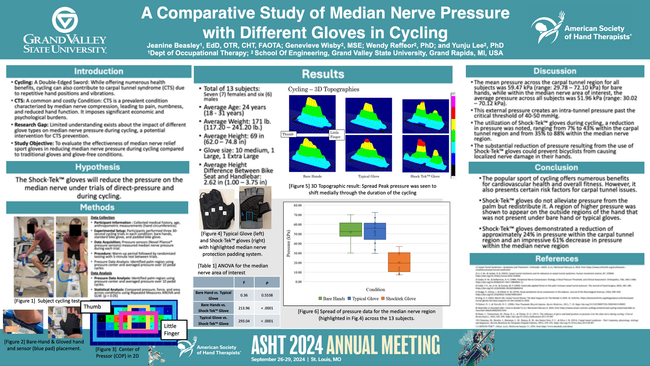
Shock•Tek™ is happy to offer access to literature which supports our claims of relieving CTS.
The following documents are in PDF form, and may be downloaded and viewed by clicking the adjacent links. You must have a copy of Adobe Acrobat Reader installed to view the documents. If you do not have the Adobe Reader, follow the adjacent link to download, and install it. https://get.adobe.com/reader/
• A Pilot Use Study to Determine the Ability of a Special Designed Glove to Relieve the Symptoms of CST.
• Occupational Hazard Study
Glossary
Axon - The thread-like part that comes out of a neuron and travels to a remote destination. It carries electrical impulses, which are the messages from that neuron.
Myelin - The insulating sheath around an individual nerve fiber. It serves to convert the axon of the nerve into a transmission line.
Ischemia - Lack of blood flow
Histology - Study of tissues using the microscope, often using special stains.
REFERENCES
1. Entrapment Neuropathies (second edition), D. M. Dawson, M. Hallett & L. H. Millender, Little, Brown & Co. Boston/Toronto 1990.
2. Luchetti R, Schoenhuber R, Alfarano M, Deluca S, De Cicci G, Landi A, Carpal Tunnel Syndrome: correlations between pressure measurement and intraoperative electrophysiological nerve study, Muscle & Nerve Dec. 1990 13:1164-11
• Pressure Reduction Data Sheet
Testimonials & Success Stories
Dr. Mark Carlson, Orthopedic Surgeon - “It’s the first glove on the market that gives the right kind of support and is made with the natural materials that won’t cause skin reactions associated with plastics. It’s such a flexible glove you can do anything with it. It certainly cuts down the immediate need for surgery. What brings people to surgery is when they can’t work or do their activities of daily living. The glove allows people to control their symptoms, so they can go back to work or do their activities. As long as you control the symptoms, you don’t have to operate. The groove is anatomically right where we make the cut for CTS release, so it (the glove) can be used to prevent symptoms, or post-operatively.”
Debbie Gaeschke, Grosse Pte. Woods, Mi. – general user - “I certainly noticed a big improvement with your gloves compared to gel gloves I had been using. There were virtually no signs of pressure on the nerves in either of my hands. Keep up the great work…I think you have truly developed something useful and worthwhile!”
Sheryl Wissman, MD, Cyclist - “I’m training, cycling 30-50 miles 2-3x/week and suffer intense hand numbness…I used your gloves…ever since. I have no numbness, pain, tingling in my fingers, wrist or elbows. What a great deal!”
Patricia Roman, Auto Worker, Oak Park, Mi. - “As an automotive worker, I do a lot of stapling and pulling for interior doors. The pain in my hands was awful. After I saw the Shock-Tek™ glove advertised a year ago, I bought it and use it daily to relive the pain I used to have. They are using it all over the plant now!”
Pest Control Manager, Kalamazoo, Mi. - “My hands would go numb and tingle after drilling only six holes in a four inch slab. I would then have to take a break. Since you sent me these gloves, I have used them every time I drill and have had no problems with my hands. With the use of these gloves, I can drill 17 holes non-stop through a 5 inch slab, stopping after 17 only because of arm fatigue from pushing the drill.”
Dr. Raymond E. Jackson, ER Physician and Cyclist - “The gloves are great. They have eliminated the numbness I used to get when riding (a bicycle).”
An Amyotrophic Lateral Sclerosis (“Lou Gehrig’s Disease”) patient, who was an active do-it-yourself shade trimmer, stopped doing everything around the house due to muscle atrophy within the palms of his hands, reduced grip, and lack of dexterity. The patient acquired a pair of ST9706 style gloves with Shock-Tek™ gel padding and resumed most of his daily activities and improving his quality of life.
A staff therapist at Team Rehabilitation, St. Claire Shores, Mi. purchased gloves for her personal use for relief of CTS symptoms. She uses the gloves on a daily basis; however, her symptoms are most noticeable while driving. She’s wearing the ST9802’s and she said she feels great behind the wheel!
Detroit Area Plastic & Reconstruction Hand Surgeon, Dr. Donald Ditmar, Jr. MD (a Shock-Tek™ Glove user) is a firm believer in Shock-Tek™ technology. Dr. Ditmar underwent trigger finger release surgery and his postoperative recovery was aided by a pair of Shock-Tek™ WG-5010 gloves. The 5010’s allowed Dr. Ditmar to resume work weeks sooner than he had expected. Dr. Ditmar recommends Shock-Tek™ to his hand patients.
Steve, Trap-Shooter, Australia - “I tried the gloves last weekend shooting trap and they were great! I showed them to another shooter with similar hand problems and he is going to order a couple of pair as well. Thanks again!”
Auto Worker, Detroit, Mi. - “In my line of work, I use my hand as a hammer to install door panels. Using your glove – no more tingling or soreness – thank you!”
Walter Roberts, Shelby Township, Mi. - “I’ve used the gloves for over a year now and no longer have the pain in my palms.”
James Riordan, Cyclist, St. Louis, Mo. - “The cycling, anti-vibration gloves are impressive. I have put over 300 miles into one pair of these gloves, and so far, it has greatly reduced the numbness in my fingers.”
Bob Pease, Cyclist, Amston, Ct. - “I bought two pair of your work gloves to wear while I mountain bike and they work great. My left hand never got numb.”
Mark Ryan, Edward Jones Company, Office Worker - “When a friend heard I was suffering from CTS, he recommended I order a pair of your Shock-Tek™ Wrist Guards. My symptoms were uncomfortable and gradually worsening. Well, I am pleased to tell you that I have been wearing them at work for a little over a month and I have noticed much improvement! Others in my office have noticed me wearing them and I have nothing but good things to say. I will continue to tell others about your great product.”
At Michigan Hand Clinic, Warren, Mi., therapists compared the Shock-Tek™ gloves to the blue Gel Glove Company’s Model TL500’s (gloves previously prescribed by Michigan Hand). The TL500’s had numerous returns after only a few weeks of patient use. No Shock-Tek™ gloves have been returned as defective since the first patient prescription. Twelve therapists all agreed that Shock-Tek™ is a phenomenal product. Quotes such as “Patients Love them!”, “What a great product!”, “Keep making them, we’ll keep using them on patients!"
Michigan Hand therapists also use the Shock-Tek™ WG-5010 work gloves on their rope pull exercise station. The WG-5010’s have been in constant use for almost three months. One of the therapists brought the gloves over for everyone to examine. "With only a little dirt and a minor amount of wear on the palm, the gloves were holding up very nicely!"
Detroit Medical Clinic therapist, Elaine, referred a hand therapy patient to Shock-Tek™ for a pair of gloves for his return to work. Patient, “Mike” had 3 surgeries to correct injuries to his middle finger and had been on disability for 22 months for an on-the-job injury. His last surgery required PIP joint replacement to his middle finger (Proximal Inter Phalangial Joint). Mike had the surgery over 12 months ago and went through a complete round of occupational therapy. He is a carpenter and is required to use hand tools including; hammers, drills, and reciprocating saws. Mike was concerned about the pain to his palm. DMC and his surgeon prescribed a neoprene sleeve to protect his middle finger from further injury. The neoprene sleeve did nothing to protect his palm from the repetitive stress and vibration. His DMC therapist and his surgeon recommended he try a pair of Shock-Tek™ gloves as a solution. Mike called Shock-Tek™ and the WG-5015 Fingerless Work Glove was recommended to provide maximum protection in conjunction with his neoprene sleeve. Only then could he comfortably return to work.
A therapist at Henry Ford Health Systems Occupational Therapy Clinic – treated Mary, a Housewife and CTS and Trigger finger Release Patient, who was unable to do the simplest of house chores due to chronic pain. She was fitted with a pair of Shock-Tek™ gloves and was able to resume work around the house without pain. Shock-Tek™ technology gave her the padding that she needed along with additional gripping power from the ST9801 gloves with silicone woven palm grips.
Mrs. B, a Henry Ford / Pearson Clinic patient - came in for a CTS consult with the Dr. due to very painful hands. She was due to have urgent hip replacement surgery and wanted surgery to remedy both conditions. Dr. Ditmar recommended that Mrs. B use Shock-Tek™ gloves and postpone CTS repair until fully recovered from the hip replacement. Mrs. B. purchased Shock-Tek™ gloves and is able to perform many activities without pain.
Eric Freeman, Detroit News Columnist, Cyclist - “The bottom line: Does the glove help? Yes, based on my experience in more than 400 miles of personal road testing in the last few weeks. The numbness in my right hand is mostly eliminated by the gloves, and it’s significantly reduced in my left hand.” (published in the Detroit News)
Product Review from “Women on Wheels” Magazine by Karol Patzer - “I found that Shock-Tek™ gloves did relieve some of the numbness I get when riding my single cylinder motorcycle. Engine vibration is transmitted to the handgrips, and after even short rides, I often have sore hands. The gloves helped reduce some of that vibration. I also used them when taking several short bicycle jaunts, and they definitely reduced the numbness I’ve been experiencing while bicycling.
Motorcyclists, who suffer from Carpal Tunnel Syndrome, or even experience tingling of their hands/fingers, may benefit from the Shock-Tek™ glove. The glove was designed by a board-certified neurologist and the design protects the median nerve from external pressure. The padded palm does prevent much of the vibration from reaching the rider’s palm.”
Product Review from Interbike Show by Uwe Adric - “ The ST9801 gloves were tested for approximately 200 miles of road and mountain bike cycling. The texture of the palm side of the gloves (stickiness) helped keep the hands on the handlebars. Many times it is very easy to, when going over sudden unexpected bumps and especially during road biking, get hands knocked off the handlebars. This texture provides a margin of safety on this regard. There was no numbing of hands during our 200 miles of testing, particularly on the mountain bike “straight” handlebars where there is a limited area to provide different hand positions. The road portion of our test also provided relief from hand numbing. Thanks again for the opportunity. We are interested in placing an order!”
Customer / Distributor List
U.S.A.
Allied Industrial Supply
Atlas Handling Systems, LLC.
Airgas Mid-America, St. Louis, MO and Bristol, PA
American Printing House for the Blind
Bruckner Supply Co.
E & R Industrial
Grainger Sourcing, Lincolnshire, IL
G. T. Midwest
Hagemeyer N. America Products Various Locations
Hagemeyer-Vallen Safety Supply Various Locations
Helgit Safety Supply
Libra Industries, Inc.
Lion Products Company Corp.
Magid Glove & Safety Mfg. Co.
Mettam's Safety Supply
Michigan Hand & Sports Rehab Center
Midwest Safety Products
Moore Medical
Northern Safety & Industrial
Orr Safety Products
Quality Mill Supply Co., Inc.
Setech, Inc.
Sullivan-Brough, Inc.
Australia
Australian Medical & Therapeutic Instruments
Normac Trading PTY. Ltd.
Kris Moonan • Occupational Therapist • Certified Hand Therapist
About Dr. Spitzer
Dr. A. Robert Spitzer, MD. Clinical Neurophysiologist, Neurologist,
Robert Spitzer, MD is a renowned neurologist and recognized expert in electro diagnosis and electrophysiology. He is a specialist in the diagnosis of Carpal Tunnel Syndrome and Occupational Neurological Injuries. Suffering tingling in his own hands as a cyclist inspired and fueled Dr. Spitzer’s invention and development of the patented technology used in Shock•Tek™ Gloves.
Dr. Spitzer has authored numerous articles and his research has been reported and acknowledged in many national and international medical journals, books and papers. As a featured lecturer, Dr. Spitzer has spoken at a variety of medical and educational seminars.
Dr. Spitzer has served on the faculty of Wayne State University as a clinical associate professor in the Departments of Neurology and Electrical and Computer Engineering. He is Board Certified by the American Board of Electro Diagnostic Medicine and the American Board of Psychiatry and Neurology, with Special Qualifications in Clinical Neurophysiology. He is a Graduate of Columbia University School of Engineering and Applied Science, and the Albert Einstein College of Medicine.
This product is NOT a medical device. It is not certified or guaranteed to treat any medical condition. We cannot diagnose carpal tunnel syndrome or certify that this product is correct. The products have been tested to reduce symptoms in many people, but there are different medical causes of hand symptoms. Anyone who is concerned may need to consult a medical professional regarding diagnosis and treatment.